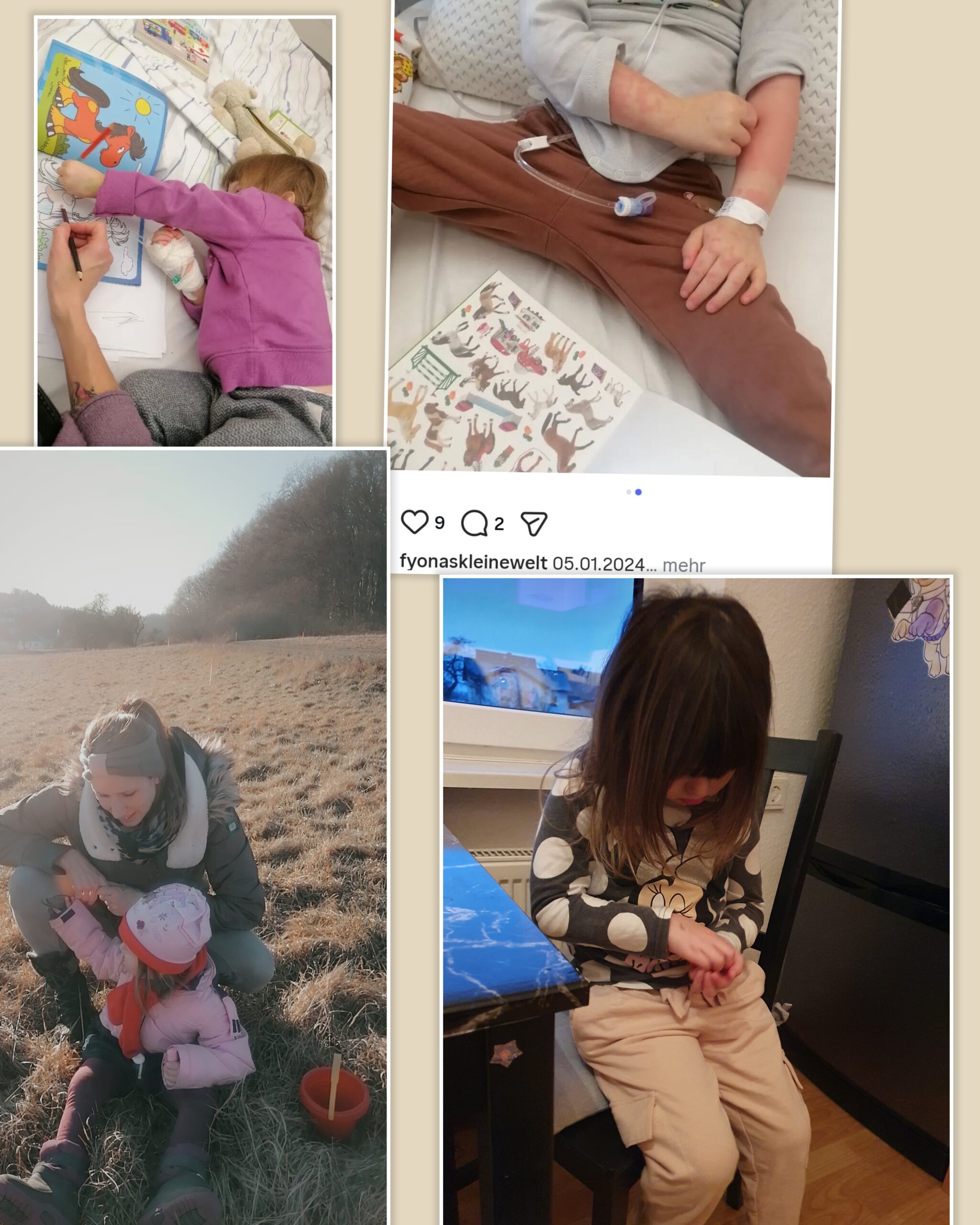
Our story is filled with sadness, fear, and despair, but also with a great deal of hope and love.
We are from Germany, in the state of Rhineland-Palatinate — more specifically, from the Westerwald region. We are a small family: mom (Jessica), dad (Daniel), and two children. Our “big” girl, Katelyn, just turned seven, and our little one, Fyona, is four years and six months old and will turn five in April.
From the moment she was born, I (Jessica) felt that something wasn’t right. After birth, Fyona wouldn’t breastfeed. It took hours before she finally latched. She was relatively small and light at birth, which didn’t worry me at first because Katelyn had also been small — not quite as small as Fyona, but still similar. We were allowed to go home, and that’s when the nightmare began. Whether breastfeeding or not, whether asleep or awake, Fyona constantly choked. She would gag, stop breathing, turn blue, and then vomit. Day in and day out. We went from doctor to doctor. No one could help. Everything was brushed off as if we were imagining it. We saw a pulmonologist, but he said everything looked fine.
Fyona wasn’t vaccinated until she was eight months old because she was constantly sick, but the pulmonologist said that as long as she didn’t have a fever, she should be vaccinated. So we did. At eight months, she began sitting up, and the episodes of turning blue became less frequent, but the choking, gagging, and vomiting continued. She would eat fruit purée pouches and vomit afterward as well (I suspect hunger was the only reason she tried to eat something she apparently couldn’t tolerate). She gained weight poorly, wasn’t growing, and refused both drinking and solid foods. The moment any puréed food touched her lips, she started gagging and vomiting.
We went from hospital to hospital and clinic to clinic. Again and again I heard the same thing: “Breastfeeding until age three is normal — if she’s hungry, she’ll eat.”
We had never felt so helpless and abandoned. You watch your child grow thinner and fear how long her body can handle it, all while fighting with doctors just to be taken seriously. Comments like that drove us to despair.
I tried to explain that breast milk is only calorie-rich during the first year and afterward is basically just fluid. I felt like no one was listening.
In one clinic, they diagnosed failure to thrive, developmental delay, a speech disorder, esophageal reflux, esophagitis, and constipation. Then we were sent home with tablets to dissolve, even though I sat in front of the doctor in tears explaining my fears. The only response was, “A cow doesn’t stop giving milk,” and that with enough liquid she would take the tablets. I was so shocked I could only cry. We went home, but she wouldn’t take the tablets, not even with a syringe in her mouth — everything came right back up.
Since birth she couldn’t tolerate anything touching her body. If she touched sand outside, her hands had to be cleaned immediately. Nothing was allowed on her face. Our doctor prescribed speech therapy, but didn’t think occupational therapy was necessary. We had to fight for every bit of help. We discussed a PEG tube with the doctor, but she didn’t think it was needed. After a long back and forth, we were finally told to go to the hospital for a nasogastric tube. I explained how sensitive Fyona is around her face, and they still wanted to try. Only if it failed would they consider a PEG.
We went, and they tried three times to place the tube. I have never felt so much pain and anger. I had to hold her on my lap, holding her arms while one nurse held her head and another her legs. They tried placing the tube; Fyona’s nose started bleeding and she gagged and vomited again. Then they tried the other nostril. I was tense and told them this had to be the last attempt. Same result. After that they said they would try once more with her lying down. Another nurse came. Again her head, arms, and legs were held down. After a struggle, they managed to place the tube, but she wasn’t even sitting up yet before she pulled it out again. We finally received a date for a PEG placement.
On December 24, 2023, we had to go to the hospital in the evening. She had an infection and constant fevers over 40°C, which we couldn’t control because she couldn’t take anything orally, and suppositories were extremely painful due to her constipation. At the hospital, they admitted us. She was exhausted and had a streptococcal infection. One doctor initially said we would get oral antibiotics and could go home, even though I had explained she couldn’t take anything by mouth. We were then admitted after all. She was given IV fluids and antibiotics. Later she also received Nexium and folic acid. Then they gave her iron intravenously, telling me to alert them if I noticed redness around the IV site. I did when it started turning red. They said they’d monitor it and to tell them if it increased. It got worse — she turned red all over, vomited, and became unresponsive. I cannot describe the thoughts that went through my mind. It was unbearable. She lay in my arms motionless. The doctor came quickly; they checked her oxygen level and blood pressure, disconnected her from the IV, and administered medications. Her oxygen was low, and she was put on oxygen and taken to monitoring. She slowly came back — a moment I will never forget.
She developed one infection after another: strep, RSV, and influenza. We were in the hospital from December 24, 2023, until January 18, 2024. On January 4, the PEG tube was placed. During this entire time, Katelyn wasn’t allowed to visit because we were on an infectious disease ward.
Feeding remained difficult — the vomiting continued. Later, in another clinic, her PEG was changed to a button PEG. There, they suggested that because I had struggled with an eating disorder (which I have well under control), my daughter might have one as well. No one should be made to feel such guilt.
The good part was that the doctor said, since they didn’t know what else to do, they would finally do a genetic test. I had been fighting for that test for two years — no doctor thought it was necessary.
On November 5, 2025, we received the diagnosis: Arboleda-Tham Syndrome (KAT6A).
It hit us hard, but at least the uncertainty was over and the constant hospital stays finally had an explanation.
Despite everything, Fyona is a happy child with a big heart.
We share her journey to raise awareness, give others courage, and hopefully connect with other affected families.
Because even though daily life is often difficult, it is full of love.
Thank you for taking the time to read our story.
Warm regards,
Jessica
German Version:
Unsere Geschichte ist mit viel Traurigkeit, Angst, Verzweiflung aber auch mit viel Hoffnung und Liebe zu erzählen.
Wir kommen aus Deutschland/ Rheinland-Pfalz wenn mans genau nimmt aus dem Westerwald.
Wir sind eine kleine Familie Mama(Jessica), Papa(Daniel) und 2 Kinder, die ,,große” Maus heißt Katelyn und ist 7 Jahre alt geworden, die kleine Maus Fyona ist 4 Jahre und 6 Monate, wird im April 5 Jahre alt.
Unsere Geschichte etwas zusammengefasst:
Von Geburt an hatte ich (Jessica) das Gefühl, dass etwas nicht stimmt. Fyona wollte nach der Geburt nicht gestillt werden, es hat stunden gedauert bis sie sich hat stillen lassen. Sie war relativ klein und leicht bei der Geburt, dass mir zu Beginn jetzt aber keine Sorgen machte, da Katelyn auch relativ klein und leicht war, nicht ganz wie Fyona aber doch schon nah dran.
Wir durften nach Hause und da fing der Horror erst an. Ob gestillt oder nicht ob schlafend oder wach, Fyona verschluckt sich ständig, bis Ie anfing zu würgen, keine Luft mehr zu holen – blau wurde und dann erbrochen hat. Tag ein Tag aus. Wir sind von Arzt zu Arzt. Keiner konnte helfen. Es wurde alles runter gespielt als würden wir uns das alles einbilden. Wir waren beim Pneumologe aber er sagte es sei alles in Ordnung. Fyona wurde bis zum 8. Monat nicht geimpft, da Sie ständig Infekte hatte aber der Pneumologe sagte solang sie kein Fieber hat soll sie geimpft werden.
Haben wir dann auch gemacht. Mit 8 Monaten fing sie an zu sitzen, da wurde es mit dem blau werden besser, das verschlucken, würgen und brechen blieb leider. Si2 nahm Quetschies zuvsich und erbrach dansch auch wieder (ich vermute es war der Hunger, weshalb sie eas zu sich nahm was sie anscheinend nicht konnte). Sie nahm schlecht zu, ist nicht wirklich gewachsen, hat Trinken und Beikost komplett verweigert, sobald sie etwas Brei an den Lippen hatte fing sie an zu würgen und zu Erbrechen.
Wir sind von Krankenhaus zu Krankenhaus von Klinik zu Klinik, immer wieder habe ich nur gehört :,, Ja bis 3 Jahre stillen sei ja normal, wenn sie Hunger hat wird sie schon essen”
So Hilflos und alleingelassen haben wir uns noch nie Gefühlt. Man muss zusehen wie sein Kind immer schmaler wird hat Angst wie lange das gut geht und muss bei den Ärzten drum kämpfen, geholfen zu bekommen. Solche Aussagen haben uns Verzweifeln lassen.
Ich habe versucht den Ärzten zu erklären, dass die Muttermilch nur das 1. Jahr kalorienreich ist, danach nur noch Flüssigkeit. Ich fühlte mich, als würde mir keiner zuhören.
In einer Klinik wurde dann die Gedeihstörung, Entwicklungsverzögerung, Sprachstörung, Ösophagealer Reflux, Ösophagitis, Obstipation festgestellt. Dann wurden wir mit Tabletten zum Auflösen nach Hause geschickt, obwohl ich weinend vor dem Arzt saß und ihm meine Ängste und Befürchtungen mitteilte. Dann hießen nur: ,, Eine Kuh hört auch nicht auf Milch zu geben” und mit Flüssigkeit wird sie die Tabletten schon nehmen. Ich wsr so geschockt das mir nur die Tränen gelaufen sind ich aber kein Wort mehr raus bekam. Wir sind heim, sie nahm die Tabletten nicht auch nicht lit einer spritze im Mund, es kam immer wieder alles raus.
Ebenso konnte sie von Anfang an nichts am Körper ertragen (Wenn sie draußen in den Sand mit den Händen kam, mussten diese immer direkt sauber gemacht werden. Es durfte auch nichts ins Gesicht. Unsere Ärztin verschrieb uns Logopädie, aber Ergotherapie hielt sie nicht für nötig. Man kämpfte für jedes bisschen. Wir haben mit dem Arzt über eine PEG-Anlage diskutiert, hielt sie nicht für nötig. Dann nach langem hin und her sollten wir ins Krankenhaus für eine Nasogastrale-Sonde, ich erklärte ihr wie empfindlich sie im Gesicht ist und dann sollte dort ein Schlauch herlaufen und festgelegt werden. Wir mussten hin und erst wenn das nicht klappt, würde sie die PEG-Sonde akzeptieren. Wir waren da 3 mal wurde versucht die Sonde zu legen, so viel Hass und Schmerz habe ich noch nie empfunden. Ich habe Sie auf meinen Schoß genommen, und sollte die Arme festhalten, eine Schwester hielt den Kopf, eine andere die Beine. Sie versuchten die Sonde zu legen Fyona blutete bereits aus dem Nasenloch etwas und würgte und hat sich wieder übergeben. Dann noch ein Versuch auf der anderen Seite, ich stand schon unter Spannung und habe gesagt das ist es letzte mal. Das selbe Spiel, bei dem anderen Nasenloch. Dann wollte sie das im Liegen versuchen, der letzte Versuch, um eine PEG gewährt zu bekommen. Quälerei mehr war das nicht. Im Liegen kam noch eine Schwester dazu, ihr wurde der Kopf, die Arme und die Beine wieder festgehalten. Sie legte die Sonde, nach Hinrunde her hat es geklappt, fyona saß noch nicht und hat sie sich wieder gezogen. Wir bekamen einen Termin für eine PEG-Anlage. Am 24.12.2023 mussten wir abends ins Krankenhaus, sie hatte einen Infekt und ständig über 40. Fieber was wir nicht runter bekamen , da Sie oral nichts zu sich nahm und Zäpfchen so schmerzhaft waren durch ihre Verstopfungen. Im Krankenhaus wurden wir dann aufgenommen, sie war existiert, und hatte eine Infektion mit Streptokkoken. Dann hieß es bei dem 2. Arzt, wir bekommen Antibiotikum mit und können gehen, obwohl ich vorher erklärte, dass sie oral nichts zu sich nimmt. Dann wurden wir doch aufgenommen. Sie bekam Infusionen (Flüssigkeit und Antibiotikum). Dann bekam sie im Verlauf auch Nexium, Folsäure dazu. Dann wurde Eisen intravenös gegeben, ich sollte mich melden wenn ich sehe das sie rot um den Zugang wird. Das habe ich gemacht als sie rot wurde, dann hieß es ja wir beobachten das, ich sollte mich melden wenn es schlimmer wird. Es wurde schlimmer, sie wsr rot am ganzen Körper, hat sich übergeben und war nicht mehr ansprechbar. Meine Gedanken in dem Moment, möchte man keinem erzählen. So unerträglich. Sie lag bei mir im Arm und regte sich nicht. Die Ärztin kam direkt, ihr wurde der Sauerstoffgehalt gemessen, der Blutdruck, sie wurde von der infusion abgemacht, ihr wurden Medikamente gespritzt. Der Sauerstoffgehalt war schlecht, sie wurde an ein Sauerstoffgerät gehangen und blieb in der Überwachung. Sie kam langsamer wieder zu sich, ein Moment den ich nie wieder vergessen werden. Sie bekam ein Infekt nach dem anderen, streptokkoken, RS-Virus und Influenza. Wir waren vom 24.12.23 bis zum 18.01.24 in der Klinik. Am 04.01.24 wurde die PEG gelegt. Eine Zeit in der uns Katelyn nicht besuchen durfte, da wir auf einer Infektionsstation lagen.
Der Anfang mit der Nahrung war auch nicht einfach das Erbrechen hörte nicht auf.
Danach waren wir später nochmal in einer Klinik, da wurde ihr die PEG zu einer Button-PEG gewechselt. Da hieß es dann da ich eine Essstörung hatte (die ich gut im Griff habe ) kann das meine Tochter auch haben. Solche Schuldgefühle habe ich keinem gewünscht.
Das gute wsr, der Arzt hat gesagt weil sie nicht mehr wussten was sie noch machen sollten, machen wir noch ein Gentest. Darum habe ich 2 Jahre gekämpft, kein Arzt hielt es für nötig.
Am 5.11.2025 bekamen wir dann die Diagnose Arboleda-Tham-Syndrom (KAT6A).
Ein Schlag den wir nicht erwartet hatten, aber die Ungewissheit hat ein Ende und die ganzen Klinikaufenthalte auch. Trotz allem ist Fyona ein fröhliches Kind, mit einem großen Herzen.
Wir teilen Ihren Weg, um aufzuklären, anderen Mut zu machen und vielleicht ein Austausch mit betroffenen Familien zu ermöglichen.
Denn auch wenn der Alltag oft schwer ist, ist er voller Liebe.
Danke, dass Sie sich die Zeit nehmen unsere Geschichte zu lesen.
Liebe Grüße
Jessica